
Perspectives: The state of the global response and why waiting is costly.
The Institute’s priorities are shaped by the global response to AMOC risk. The Institute’s perspective is that a serious response requires three things: Prevention, Detection, Preparedness. In each, a global response is taking shape. However, a delay in action carries considerable cost.
-
Every serious response to AMOC risk starts with emissions reduction – that hasn't changed. But the cooperation it depends on has stalled, and some governments aren’t waiting. Coalitions of willing states are moving ahead of the collective, as in the Santa Marta process.
Separately, governments have begun funding research into solar radiation modification – reflecting a small fraction of incoming sunlight to reduce warming. Whether these options prove viable is unsettled. That governments are funding the examination is new.
Unfortunately, the longer the wait, the more the main strategy of prevention loses its political fuel. The multilateral emissions strategy depends on public and political support to keep going. But the longer it visibly underdelivers, the more people quietly conclude it’s not working. Public support, once lost, can’t be relied on to return.
Backup options have a hidden and dangerous deadline. Measures that go beyond emissions cuts are mostly early-stage, with no reliable timeline. Where an estimate exists, deployment readiness is ten to twenty years away. Options that take two decades to prepare cannot be reached for at the moment they’re needed. They have to be examined now.
-
Knowing how the AMOC is changing – and how fast – depends on sustained ocean observation. Until recently, this was treated as a scientific priority. Now, governments, including Iceland, the Nordic countries, and the Netherlands, are beginning to see it as a security matter. The EU OceanEye initiative and the UK’s forecasting work on Arctic and sub-Arctic tipping points related to the AMOC are the most concrete steps. The funding and governance that would make this durable haven’t followed yet – recognition has outrun the funding.
The danger is that the observation network is more fragile than it looks. The systems that monitor the AMOC run on short-term funding across national programmes with no shared authority, and the future of US funding is uncertain.
And detection takes time: twenty-five to forty years of unbroken measurement for a trend to separate from natural variation. Today, the longest records run fifteen to twenty years. A gap in measurement would reset a clock that needs to be running continuously.
-
Some of what AMOC weakening would bring can’t be prevented; it can only be managed. Iceland elevated AMOC risk to its national security council; Finland took concrete steps to treat it as a security threat; the Nordic governments adopted a common position; the Netherlands gave it new prominence in its updated Arctic policy. What a preparedness strategy looks like in practice is still being worked out.
The harsh reality is that preparation gets harder the longer it’s deferred. Every major flood, wildfire, or weather disruption pulls public money toward recovery and away from readiness. The loop tightens as disruptions grow.
Economic damage can also start before any physical change happens. If the science points toward a pessimistic outcome, markets begin pricing in the risk – property values fall, credit tightens, investment leaves – well before the AMOC has actually weakened. Learn more here.
How Reykjavík Institute addresses the challenge.
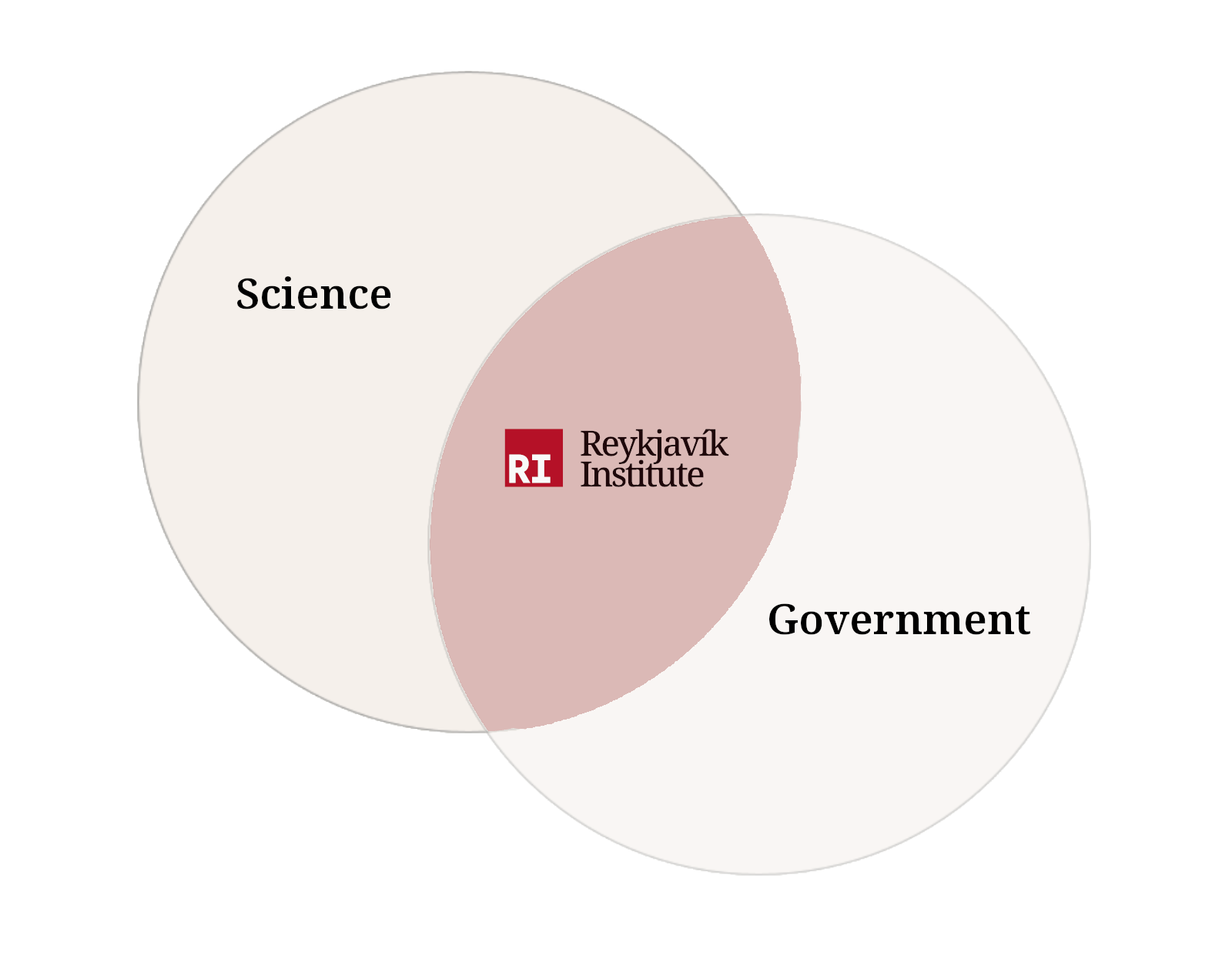
When it comes to addressing AMOC collapse risk, what is missing is not understanding or intent. Scientists see the risk, ministries are prepared to act, states want to move together. What is missing is a body whose task is to keep the windows open – to carry the evidence from the people who generate it to the people who decide, to ready coalitions that keep our options alive across decades.
That work has no home. Observation runs across separately funded national programmes with no shared authority. Nations that recognise the same threat recognise it separately. There is no venue whose job is the space between – and it is precisely in that space that the windows closing.
That is the gap the Reykjavík Institute exists to close. The Institute does not duplicate the work of researchers, nor campaign for a predetermined answer. It is the connective layer between the science and the state, and between the governments that will have to act together – coordinating the evidence, the relationships, and the coalitions through which recognition becomes response.
1. Prevention
The Institute is working on getting a climate strategy fit for AMOC and tipping-point risk onto the government agenda. We support serious, parallel examination of options beyond emissions reduction, so credible choices stay open rather than foreclosed.
2. Detection
The Institute is working on securing the funds and governing structure for a permanent, multinational AMOC early-warning system. It’s the infrastructure that the whole response depends on, and that no single government can build alone.
3. Preparedness
The Institute is committed to building the coordination a preparedness response requires. We are prepared to connect scientific bodies, governments, and public agencies around a common strategy for managing what cannot be prevented.
Our priorities.
The Institute’s core priorities are to build political recognition that AMOC collapse is a risk governments must act on, and convert that momentum into coordinated and funded action.
Achieved: Iceland designates AMOC risk as a matter of national security.
In September 2025, Iceland became the first government to treat the risk of AMOC collapse as a national security matter. The designation followed a framing the Institute put in front of Icelandic decision-makers: AMOC risk is not a distant environmental concern, but a present question of national security. In the months that followed, the Institute supported the government’s earliest work on how to respond.
-
April – July 2025: Briefings to the Central Bank of Iceland, the National Security Council’s preparatory committee, and the Ministry for the Environment, Energy and Climate
June 2025: Formal commentary on the proposed Climate Act, filed in the government’s legislative consultation process →
August 2025: Op-Ed published – “Loftslagsverkfræði: Verkefni sem borgar sig ekki að láta bíða” (Vísir) →
September 2025: Address to the Environmental Assembly
September 2025: Snjólaug Árnadóttir, RÚV Kastljós →
Following the designation:
October 2025: Organized a science–policy side event at Vinnustofa Kjarval, bringing foreign experts together with officials from across Iceland’s ministries and agencies, and policymakers from the other Nordic countries – “Convening the AMOC: Envisioning a Resilient North” →
October 2025: Prepared a AMOC national-security brief for the Icelandic government’s response process – “Nordic AMOC Risk and National Security Outlook” (PDF) →
November 2025 – January 2026: Participation in the Icelandic government’s early inter-ministerial discussions on how to respond
-
Achieved: Nordic governments recognise the AMOC threat
The Institute worked to carry AMOC risk recognition beyond Iceland and into the wider Nordic conversation. Through convening, briefing, and shared analysis, the Institute built the connections between governments and experts that a regional response requires. At a Nordic Council of Ministers meeting in Copenhagen in May 2026, Nordic ministers discussed the AMOC:
“Among the Nordic ministers, there was consensus on the importance and seriousness of the issue. Ultimately, it is about being able to maintain the current living conditions in all Nordic societies and it is the responsibility of politics to respond.”
-
October – November 2025: Informal briefings with policymakers across several Nordic governments, following the “AMOC: Envisioning a Resilient North” event →
November 2025: Developed a public Nordic AMOC security memo – “Nordic AMOC Risk and National Security Outlook” (PDF) →
December 2025 – January 2026: Facilitated a collaboration between Johan Rockström and Minister Jóhann Páll Jóhannsson, resulting in a joint op-ed on AMOC risk as a security concern – “Climate Risk Becomes a Matter of Security” →
February 2026: Convened a foresight discussion on AMOC early-warning development at Arctic Frontiers, Tromsø – with scientific advisors, research planners, and diplomats from across the Nordic countries, alongside Arctic Stabilization Initiative
April – May 2026: Prepared a report prepared with researchers and scientific advisors from Denmark, Sweden, Finland, and Iceland, and circulated to Nordic ministries and their scientific advisory bodies – “AMOC Observation as Critical Infrastructure” · On the fragility of AMOC observation systems (PDF) →
Current Priority: Building the coalition for a permanent AMOC early-warning system
Detecting a weakening AMOC in time depends on sustained observation of the ocean. Today that observation runs on separately funded national programmes, with no shared authority over the whole and no durable home – much of it renewed year to year.
The scientists who run these observing systems are at the front line of the problem. They operate the arrays, and they are the ones warning, from direct experience, how precarious the funding has become. What they often lack is a channel into the policy world equal to the stakes – a way to make the case land with the ministries, finance authorities, and security bodies that could give observation a lasting mandate.
The Institute helps translate the scientific findings into a case that reaches decision-makers: most directly in AMOC Observation as Critical Infrastructure, prepared with contributors responsible for running both the OSNAP and RAPID transatlantic arrays and the Nordic and Arctic gateway and overflow monitoring, which sets out both the fragility of the current arrangement and what a durable system would require.
Array operators have made the same case in public. See The Guardian · Holliday, de Jong & Groeskamp · “AMOC Collapse Could Change Europe’s Climate 10x Faster Than Expected. We Aren’t Ready” →
That case is increasingly reflected in the institutional record. The Nordic Council of Ministers report (Nordic Council of Ministers · Nummelin et al. · “A Nordic Perspective on AMOC Tipping: Impacts and Strategies for Prevention and Governance” →) set out the scientific basis. In May 2026, a unified Nordic position from the Council of Ministers named observation a priority. And in June 2026, the Netherlands’ updated Arctic policy singled out AMOC observation specifically. In under half a year, sustained monitoring has moved from a scientific concern to a stated position across several governments.
The Institute works across the wider system – between national governments, EU and UN institutions – on the practical question of how sustained observation gets funded and run. That work is most concrete now around the OceanEye Initiative, where governments weigh how to commit, against a backdrop of growing strain on the funding that keeps key observing systems running.
Current Priority: Getting a climate strategy fit for AMOC and tipping-point risk on the government agenda
Reducing the likelihood of AMOC collapse begins with cutting emissions. This is necessary and has no substitute. However, a serious risk strategy also has to ask what happens if emissions cuts do not come fast enough, and which options would then remain. This is where climate policy is least prepared to think clearly. The options beyond mitigation are among the most contested questions in the field, and the debate around them is polarised to the point where governments can barely examine them at all. In Iceland, the absence of any government position has itself become the stated reason for refusing the research that might inform its position.
The case for examining these options now, rather than after the window to prepare them has closed, is set out in the Institute’s Nordic AMOC Risk and National Security Outlook (Reykjavík Institute · Gunnarsson · “Nordic AMOC Risk and National Security Outlook” → PDF), which traces how long such options take to become viable and how early that examination would have to begin.
A serious response cannot rest on options no one is willing to name. A nation exposed to a risk this severe can legitimately decide to lead in developing the means to reduce it, including stabilisation research. Whether it should is a real question with a real case on both sides. The Institute has made that case, and makes no apology for it. Where a government lands is for the government to decide – it holds the mandate, and the responsibility to keep its people safe.
The Institute’s role is to make sure that decision is an informed one.
-
August 2025: Op-ed with Snjólaug Árnadóttir on how the absence of a government position has become the reason for refusing the research that might produce one – “Loftslagsverkfræði: Verkefni sem borgar sig ekki að láta bíða” (Vísir) →
October 2025: Convened an accompanying event at the Arctic Circle Assembly: “AMOC: Envisioning a Resilient North” →
March 2026: Published a thought leadership piece on a nation’s right to examine and prepare its own responses to an existential threat – “Iceland and the AMOC: When Existence Is at Stake” (SRM360) →
March 2026: Roundtable on climate-intervention research, Arctic Circle Assembly Rome Forum
March 2026: Co-convened a public forum at Reykjavík University examining the arguments for and against climate engineering – with government, civil-society, legal, public-opinion, and media voices, including Landvernd, Ungir Umhverfissinnar, and Varða